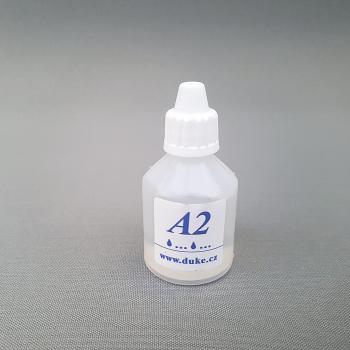
Drop tester – DUKE A (alkalinity)
tester for determining water alkalinity
9,07 € exc. VAT
.jpg)
.jpg)
.jpg)
Dropper-style alkalinity tester. Properly set alkalinity stabilizes pH, reduces consumption of pH adjustments, and increases chlorine effectiveness. Suitable for testing alkalinity for both chlorinated and non-chlorinated pool water treatment. Ideal pH value 6.8–7.2 Optimal alkalinity 80–120 mg/l (ppm).
The reason you cannot easily calculate how much the pH will change is the total alkalinity value. If this value is too high, the pH is often too high as well, and in addition it shows a high degree of stability — it has so-called high buffering capacity. If the total alkalinity (TA) is too low, the pH is not stable and exhibits very large and frequent fluctuations.
Alkalinity - definition
The measure of the content of hypothetical salts in water, bound to ions of weak acids – bicarbonates and carbonates in hydrochemical Palmer’s classification.
Total alkalinity - represents the sum of basic substances dissolved in water that prevent sudden pH changes. The optimal value of total alkalinity ranges from 80 to 120 mg/l. It affects disinfection efficiency, pH adjustment, formation of precipitates of various components from water, and corrosion of metal parts.
Too high total alkalinity is caused by a high content of bicarbonate anions. Water with high TA has a large neutralization capacity and it is very difficult to change its pH. First, it is necessary to consume, neutralize, the bicarbonate anions present in the water, and only then does the pH begin to change. Water with high TA usually also has high pH, and that cannot be reduced easily. In this case, the consumption of acid increases significantly, as does disinfection, because as already mentioned, at higher pH the chlorine effectiveness decreases.
Too low total alkalinity means that there are too few bicarbonate ions in the water. Then even a very small dose of the appropriate product is enough to cause a very sharp drop or rise in pH. In such water, for example, pH drops significantly (even to around 4.00) simply by dosing gaseous chlorine, and adding a product to raise pH is not enough to increase it. Even water with proper total alkalinity can become unstable in pH adjustment when dosing gaseous chlorine, because the added chlorine “consumes” bicarbonate ions. Usually this does not happen, because the treated water brings in new bicarbonates and this negative chlorination effect is eliminated.