Drop tester – DUKE CP (cl/pH)
for determining free and total chlorine and pH
12,58 € exc. VAT
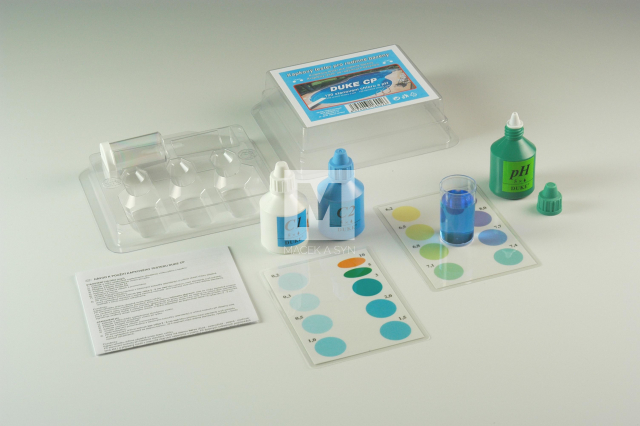
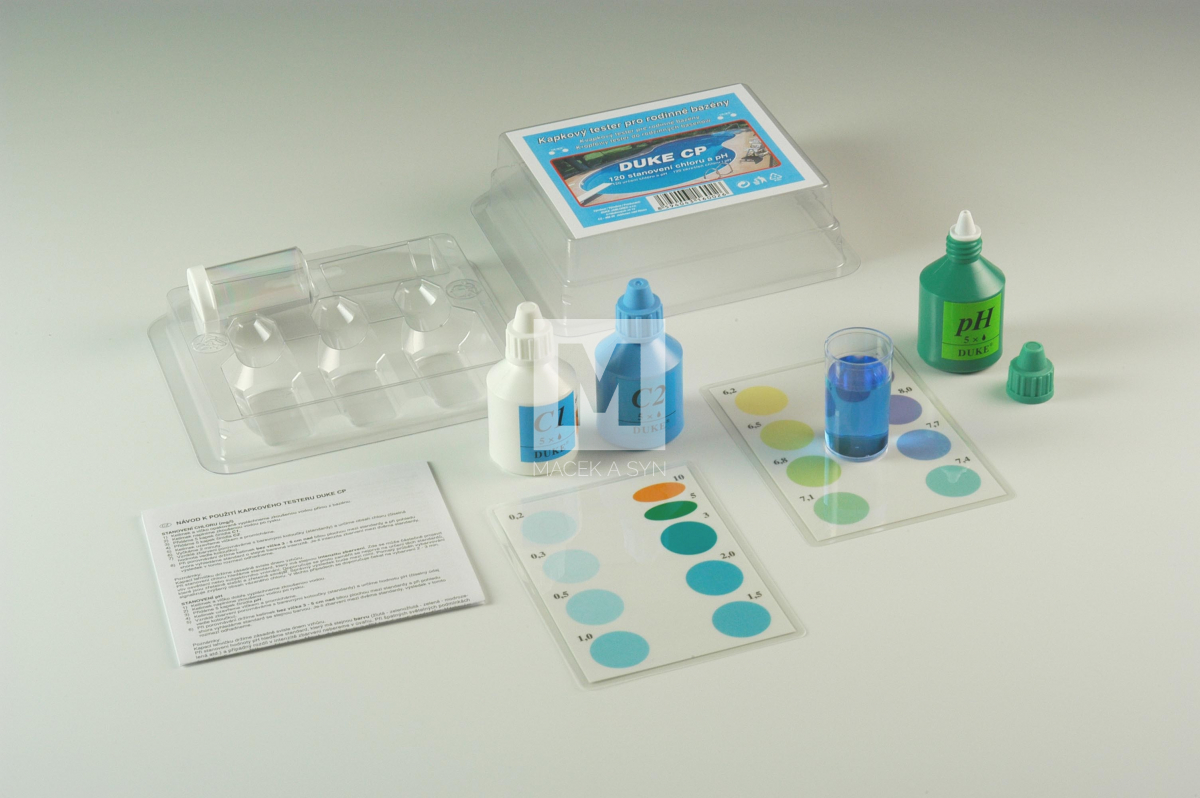
- 120 determinations of free and total chlorine (0.2 - 10 mg/L)
- 120 determinations of pH (6.2 - 8.5)
Contains technical information on water treatment and dosing of chemicals.
Recommended ranges for chlorine content and pH.
| Free chlorine content | 0.3 - 0.5 mg/L |
| Combined chlorine content | as low as possible, max. 0.3 mg/L |
| pH value | 6.5 - 7.4 as optimal, in justified cases may be allowed as low as 6.0 or 8.0 |
Recommendations from pool chemical suppliers may differ slightly, reflecting the requirement to adhere to certain optimal conditions when using the supplied chemicals.
Free chlorine is the portion that remains unbound after dosing, e.g. in the form of hypochlorite. With the DUKE® CP tester it is possible to perform a quick determination of free chlorine, immediately after adding reagents without waiting. The reaction with bound chlorine is slow.
Combined chlorine is the portion of active chlorine that has been dosed into the water and binds only weakly to nitrogenous compounds, such as ammonium ions, urea, which mainly come from human skin and are present in sweat. It is important to wash and shower before entering the pool! Combined chlorine remains active chlorine and retains disinfection effect, although somewhat weaker than free chlorine. Compounds of chlorine with nitrogenous substances are called chloramines. The simplest of them, derived from ammonia, are health-hazardous. Therefore their content is limited in the regulation precisely by the content of bound chlorine. When the content of bound chlorine is elevated, it is advisable to “dilute” the pool water with clean water.
Combined chlorine cannot be directly measured; its content is calculated from the difference – total chlorine minus free chlorine.
Total chlorine (active) is the sum of free and combined chlorine. With the DUKE® CP tester it is determined by adding reagents C1 and C2 and waiting 2 minutes for the bound chlorine to react.
